




RQF and Ofqual: How UK Qualifications Work
If you are choosing a qualification in the UK, you may come across terms such as RQF, Ofqual, regulated qualification and awarding organisation. These terms are closely connected, but they do not mean the same thing.
Understanding how they work can help you check whether a qualification is genuinely regulated, compare different levels and choose a course that fits your career goals.
In simple terms, Ofqual regulates qualifications and awarding organisations in England, while the Regulated Qualifications Framework (RQF) helps describe regulated qualifications by their level and size.
Table of Contents
What Is Ofqual?
Ofqual stands for the Office of Qualifications and Examinations Regulation. It is the qualifications regulator in England and oversees recognised awarding organisations and the qualifications within its remit.
Ofqual does not normally teach learners or act as a training provider. Instead, it sets regulatory rules that recognised awarding organisations must follow when developing, assessing and awarding regulated qualifications.
Its role helps create a structured system around areas such as:
- qualification design;
- assessment;
- qualification levels and size;
- quality assurance;
- awarding and certification.
For learners, this makes it easier to understand what a regulated qualification represents.
What Is the Regulated Qualifications Framework?
The Regulated Qualifications Framework is the system used to describe regulated qualifications and help learners and employers understand how they relate to one another.
Ofqual introduced the RQF in 2015 as a single framework for describing regulated qualifications. Its purpose is to help learners, employers and training organisations understand how qualifications relate to one another.
The framework mainly describes qualifications using two important features:
Level – indicates the relative difficulty or complexity of the qualification.
Size – reflects the amount of learning and assessment associated with the qualification.
This means two qualifications can be at the same RQF level but still differ significantly in subject, purpose and study time.
RQF vs Ofqual: What Is the Difference?

The simplest way to understand the relationship is:
Ofqual = the regulator
RQF = the framework used to describe regulated qualifications
Ofqual sets the regulatory conditions and recognises awarding organisations.
The RQF helps organise and describe qualifications using levels and size.
They therefore work together, but they have different functions.
For example, a Level 3 qualification may appear on the RQF because it is part of the regulated qualifications system. Ofqual is the regulator overseeing the awarding organisation responsible for that qualification.
How Do RQF Levels Work?
Official guidance on qualification levels explains that higher levels generally represent more difficult learning, helping learners compare the relative level of different qualifications. GOV.UK explains that higher qualification levels generally represent more difficult learning.
The framework runs from Entry Level to Level 8.
For the qualifications discussed in this guide, Levels 3 and 4 are particularly relevant.
Level 3
Level 3 qualifications involve more advanced learning than Level 2 and are commonly used for vocational development, teaching, assessment and school-support pathways.
Examples include:
- Level 3 Certificate in Assessing Vocational Achievement;
- Level 3 Award in Education and Training;
- Level 3 Award in Supporting Teaching and Learning in Schools.
Level 4
Level 4 qualifications represent a higher level of difficulty and can involve more advanced knowledge, professional responsibility and applied practice.
Examples include:
- Level 4 Certificate in Education and Training;
- Level 4 Award in Internal Quality Assurance;
- Level 4 Certificate for Higher Level Teaching Assistants.
However, a higher level does not automatically mean a qualification is more suitable for your career. Relevance to the role is just as important.
What Is an Awarding Organisation?
An awarding organisation develops and awards qualifications.
To offer qualifications regulated by Ofqual, an awarding organisation must gain recognition and comply with Ofqual’s regulatory conditions.
Focus Awards is an Ofqual-regulated awarding organisation offering regulated qualifications within the RQF across a range of vocational sectors. It states that Ofqual has approved it to offer regulated qualifications across a range of sectors.
An awarding organisation may be responsible for:
- developing qualification specifications;
- defining assessment requirements;
- approving centres;
- maintaining quality assurance;
- awarding qualifications;
- overseeing certification.
This is different from the role of the organisation through which you actually study.
What Does the Training Provider Do?

A training provider or approved centre normally delivers the qualification to learners.
Its responsibilities can include:
- providing learning materials;
- offering tutor or assessor support;
- carrying out assessments;
- reviewing evidence;
- supporting learner progress;
- internally quality-assuring assessment decisions.
The awarding organisation and training provider therefore work together but perform different roles.
For example, if you complete a Focus Awards qualification through NextGen Learning, Focus Awards is the awarding organisation while NextGen Learning is the training provider delivering the programme.
How Does a Qualification Become Regulated?
The official Register of Regulated Qualifications allows learners to check whether a qualification is regulated, review its details and compare it with similar qualifications.
You can use it to:
- check whether a qualification is regulated;
- confirm its official title;
- identify the awarding organisation;
- review qualification details;
- compare similar qualifications.
This is particularly important when different providers use similar course names.
Checking the register helps you understand exactly what qualification you are enrolling on before investing your time and money.
Why Do RQF Qualifications Matter for Career Development?
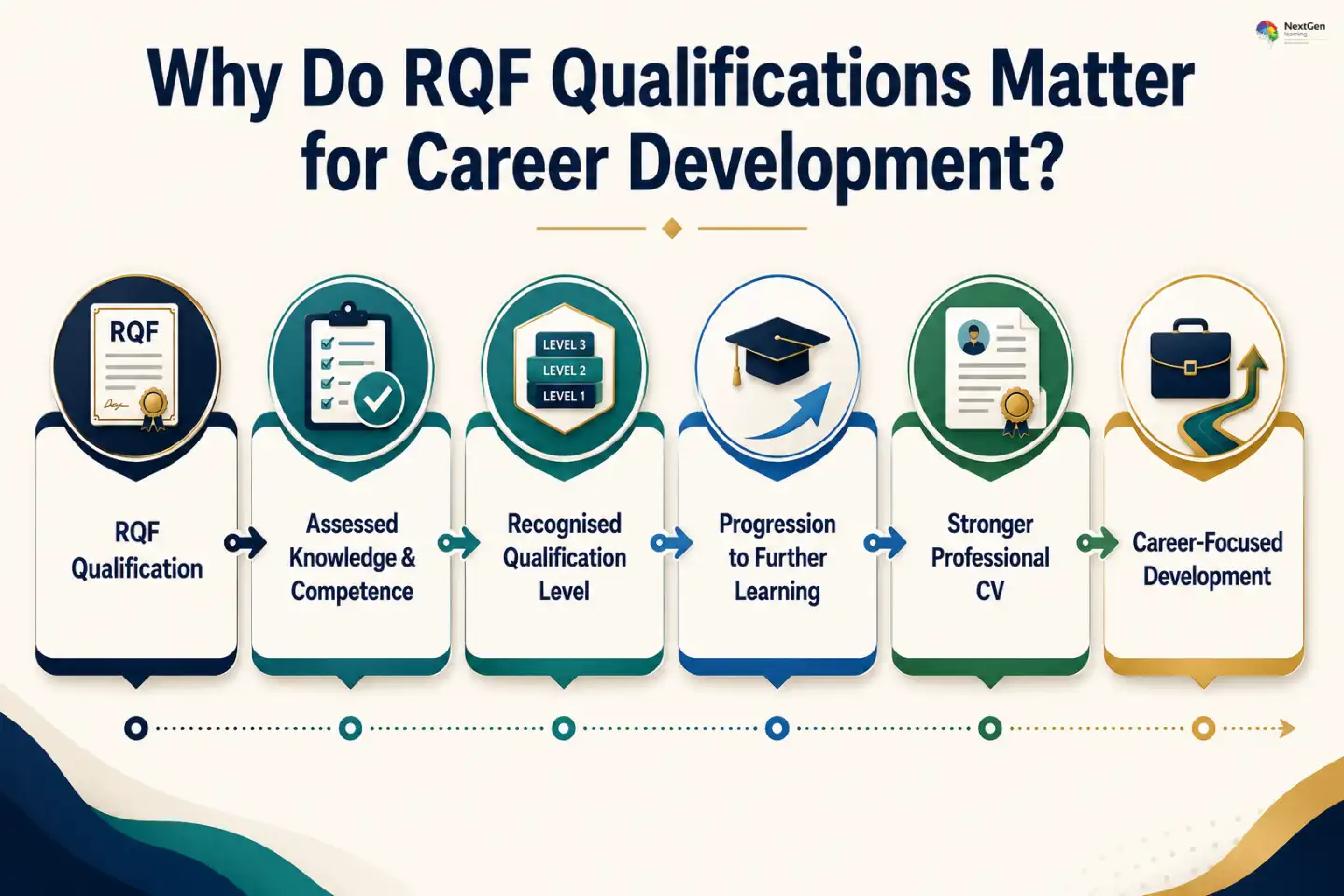
RQF qualifications can provide clearer evidence of structured learning and formal assessment. Their value is strongest when the qualification directly matches the career or responsibilities you are aiming for.
They can help learners:
- demonstrate assessed knowledge and competence;
- show a recognised qualification level;
- support progression to further learning;
- strengthen a professional CV;
- provide clearer evidence of career-focused development.
However, an RQF qualification does not automatically guarantee employment. Employers may also consider experience, practical competence, safeguarding requirements and other role-specific criteria.
Which RQF Qualification Could Support Your Career?
The right qualification depends on the pathway you want to follow.
1. Level 3 Certificate in Assessing Vocational Achievement (RQF)
Suitable for professionals who want to assess vocational learners in workplace and training environments. It can support progression into vocational, workplace or apprenticeship assessor roles.
2. Level 4 Certificate in Education and Training (RQF)
Designed for aspiring or existing teachers and trainers who want to develop more advanced knowledge of teaching, assessment, lesson planning and learner support.
3. Level 4 Award in Internal Quality Assurance (RQF)
A relevant progression route for experienced assessors moving into internal quality assurance. It develops knowledge of monitoring assessment decisions and maintaining consistent standards.
4. Level 3 Award in Supporting Teaching and Learning in Schools
Suitable for learners interested in Teaching Assistant and classroom-support roles. It develops knowledge related to safeguarding, communication, pupil support and inclusive learning.
5. Level 3 Award in Education and Training (RQF)
A practical starting point for people entering teaching or workplace training. It introduces core principles including inclusive teaching, professional responsibilities and assessment.
6. Level 4 Certificate for Higher Level Teaching Assistants
Designed for experienced Teaching Assistants developing towards greater classroom responsibility. It can strengthen knowledge of learner support, interventions and higher-level classroom practice.
RQF Qualification or CPD Course: What Is the Difference?

An RQF qualification and a CPD course can both support professional development, but they serve different purposes.
An RQF qualification sits within the regulated qualifications system and follows defined assessment and awarding requirements.
A CPD course is generally designed to update, refresh or extend professional knowledge. It does not automatically become an RQF qualification simply because a certificate is issued.
For many professionals, the two can work together: a regulated qualification can support a core career pathway, while CPD helps maintain and expand skills over time.
How Should You List an RQF Qualification on Your CV?
Use the complete qualification title and, where appropriate, identify the awarding organisation.
For example:
Level 3 Certificate in Assessing Vocational Achievement (RQF)
Awarding Organisation: Focus Awards
Training Provider: NextGen Learning
This makes it easier for employers to understand what you studied, the qualification level and who awarded it.
How to Choose the Right Qualification

Before enrolling, ask:
- Does the qualification match my career goal?
- What RQF level is it?
- Who is the awarding organisation?
- Is the qualification officially regulated?
- What assessments or workplace evidence are required?
- Does my preferred employer expect additional experience or qualifications?
The best choice is not necessarily the highest-level course. It is the qualification that most closely matches your intended role and progression route.
Final Thoughts
Understanding RQF and Ofqual makes the UK qualifications system much easier to navigate.
Ofqual is the regulator, the RQF provides the framework for describing regulated qualifications, awarding organisations develop and award qualifications, and approved training providers deliver the learning and assessment.
For learners, knowing these differences makes it easier to check whether a qualification is regulated, understand its level and choose a programme that supports a genuine career goal.
If you are considering a pathway in vocational assessment, teaching, internal quality assurance or classroom support, explore NextGen Learning’s regulated qualifications and compare the available options before deciding on your next step.
Frequently Asked Questions
RQF stands for the Regulated Qualifications Framework. It is used to describe regulated qualifications in England by their level and size, helping learners and employers understand the relative difficulty and scope of a qualification.
Ofqual is the regulator, while the RQF is the framework used to describe regulated qualifications. Ofqual oversees recognised awarding organisations and regulated qualifications, while the RQF helps show where qualifications sit by level and size.
Qualifications listed on the RQF fall within the regulated qualifications system in England. Learners should still verify the exact qualification, awarding organisation and regulatory status using the official qualification register.
You can search the official Register of Regulated Qualifications using the exact qualification title or awarding organisation. It allows you to check details such as the qualification level, number, awarding organisation and regulatory status.
RQF levels indicate the relative difficulty of a qualification. The framework runs from Entry Level to Level 8. A Level 4 qualification is more demanding than a Level 3 qualification, although qualifications at the same level can differ in subject and size.
They serve different purposes. An RQF qualification provides structured, formally assessed learning within the regulated system, while CPD is generally used to update or extend professional knowledge. The right option depends on your career and learning goals.
Yes. A relevant RQF qualification can strengthen your CV by demonstrating structured learning, formal assessment and a recognised qualification level. For clarity, include the full qualification title and awarding organisation when listing it.



0 responses on "RQF and Ofqual: How UK Qualifications Work"