




Teaching Assistant Apprenticeship: Pay & How to Apply
Want to work in a school but unsure whether you need qualifications or previous classroom experience? A teaching assistant apprenticeship could offer a practical way to start. You earn a wage while developing the skills needed to support teachers and pupils.
Before applying, check entry requirements, pay, training and genuine vacancies.
This guide explains how Level 3 teaching assistant apprenticeships work in England, what you could earn in 2026 and how to prepare an application.
Table of Contents
What Is a Teaching Assistant Apprenticeship?
A teaching assistant apprenticeship is paid employment combined with structured workplace training. In England, the Level 3 programme typically takes 18 months of training, followed by assessment. Apprentices support pupils and teachers while developing practical skills through supervised school experience and planned study. Unlike a standalone online course, an apprenticeship requires an employer.
The official Level 3 teaching assistant apprenticeship standard, known as ST0454, sets out the responsibilities and competencies apprentices must develop.
What Does a Level 3 Teaching Assistant Apprentice Do?
Your responsibilities may include:
- Helping pupils understand classroom instructions and activities.
- Supporting teachers with learning resources and classroom routines.
- Working with small groups or individual pupils.
- Encouraging positive behaviour and inclusive learning.
- Following safeguarding procedures and reporting concerns appropriately.

Some schools support pupils with special educational needs and disabilities (SEND).
Individual-pupil support may become a specialist responsibility, depending on experience and school expectations.
Teaching Assistant Apprenticeship Entry Requirements
You do not necessarily need previous school employment to apply. However, eligibility for an apprenticeship and selection requirements set by a school are different things.
Age, GCSEs and English and Maths Requirements
Under England’s apprenticeship eligibility rules, applicants generally need to be:
- At least 16 years old.
- Living in England.
- Not in full-time education when starting the apprenticeship.
There is no general upper age limit.
Schools may request GCSEs in English and maths, often at grade 4/C or above. However, individual employers determine their recruitment criteria, so check each vacancy rather than assuming every position has identical requirements.
Current English and maths apprenticeship guidance also distinguishes apprentices by age. Those aged 16–18 at the start must achieve the required qualifications if they do not already hold accepted equivalents. For apprentices aged 19 or over, relevant English and maths training can form part of the training plan by agreement with their employer.
Can You Apply Without Experience?
Yes. A teaching assistant apprenticeship with no experience is a realistic option where the employer accepts entry-level applicants.
What matters is showing that you have qualities suitable for working with children.
For example, customer service experience may demonstrate patience and communication. Volunteering could provide examples of teamwork, reliability and responsibility.
Schools may value applicants who can listen carefully, follow instructions, remain calm and recognise when they need help from a teacher.
Before applying, it may also help to understand the different teaching assistant qualifications and how they compare with apprenticeship training.
You do not automatically need to complete a separate paid course before applying.
Teaching Assistant Apprenticeship Pay and Salary in the UK
Teaching assistant apprenticeship pay depends on your age, apprenticeship year, contracted hours and employer.
How Much Does a Teaching Assistant Apprentice Earn?
From 1 April 2026, the statutory National Minimum Wage rates are:
| Wage category | Minimum hourly rate |
|---|---|
| Apprentice rate | £8.00 |
| Age 18–20 general rate | £10.85 |
| Age 21 and over general rate | £12.71 |
Important: The £8 apprentice rate applies to apprentices under 19 and to those aged 19 or over in their first apprenticeship year. Once apprentices aged 19 or over have completed that first year, the age-related minimum applies. These figures are legal hourly minimums, not typical salaries; employers may pay more.
Why Can Advertised Apprenticeship Salaries Differ?
Consider two hypothetical vacancies, both paying £8 an hour:
| Example | Paid weekly hours | Weekly gross pay |
|---|---|---|
| Vacancy A | 30 hours | £240 |
| Vacancy B | 37 hours | £296 |
These are hypothetical gross weekly earnings before tax and other deductions, calculated using paid hours only; neither example represents an advertised vacancy.
Annual earnings also depend on paid weeks, holiday arrangements and whether the role is term-time only.
An advertised full-time equivalent (FTE) salary may be higher than the amount actually paid under a part-time or term-time contract.
Before accepting an offer, ask the employer to confirm your gross annual pay, paid training hours, holiday entitlement and whether the salary changes after your first apprenticeship year.
How Long Does a Teaching Assistant Apprenticeship Take?
England’s Level 3 teaching assistant apprenticeship typically takes 18 months, although actual duration can vary according to the training arrangement and relevant prior learning.
Training, Classroom Experience and Assessment
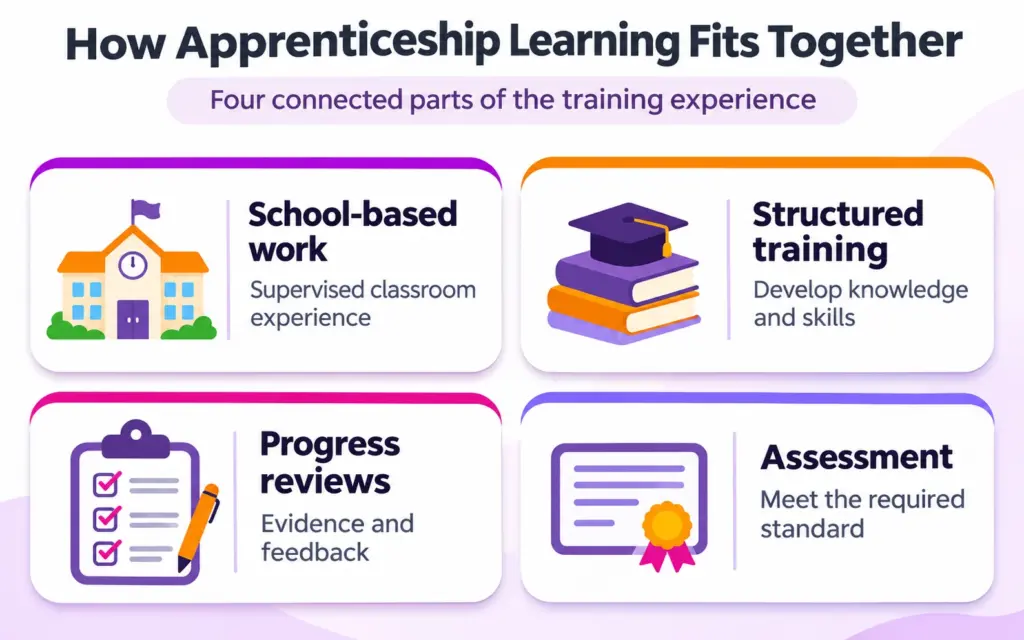
You will develop your skills through a combination of:
- Supervised work with pupils and teachers.
- Structured learning with an apprenticeship training provider.
- Workplace mentoring and progress reviews.
- Assignments or activities demonstrating your knowledge and skills.
- Assessment against the applicable apprenticeship standard.
Under the official off-the-job apprenticeship training guidance, required training takes place during working hours, rather than being additional unpaid study in your personal time.
The training develops knowledge, skills and behaviours, commonly called KSBs.
For example, an apprentice might study how to support inclusive learning, then apply appropriate techniques under supervision in the classroom.
Training and assessment arrangements should be confirmed with the employer and provider because apprenticeship standards can change.
An apprentice teaching assistant also has different responsibilities from a cover supervisor, whose work may involve supervising classes during a teacher’s absence. Apprentices should expect supervised development rather than immediate responsibility for every classroom task.
How to Find and Apply for a Teaching Assistant Apprenticeship
Finding the right vacancy is as important as preparing a good application. A school must be offering a suitable apprenticeship opportunity; simply enrolling with an independent course provider does not secure an apprenticeship job.
Step 1 — Find Teaching Assistant Apprenticeship Vacancies
Start with the official GOV.UK service to find teaching assistant apprenticeship vacancies in England.
Try different search terms, including:
- Teaching assistant apprentice
- Level 3 teaching assistant apprenticeship
- Apprentice learning support assistant
- School teaching assistant apprenticeship
Search using your postcode and an appropriate travel distance. You can also check school websites, academy trust recruitment pages and local authority vacancy listings.
Check advertised closing dates carefully. Opportunities vary by location and employer, and schools recruit at different times.
Step 2 — Check the Vacancy Before Applying
Do not judge an apprenticeship solely by its advertised salary.
Check the following details:
- Employer: Which school or academy trust will employ you?
- Requirements: What qualifications, skills or experience are requested?
- Pay: Is the advertised amount hourly, annual or full-time equivalent?
- Working pattern: Are the hours term-time only or year-round?
- Training: Who provides the apprenticeship training, and how is it organised?
- Application: What documents are required, and when does recruitment close?
If important information is missing, contact the employer before applying.
This clarifies working hours, training and salary expectations.
Example: comparing two hypothetical offers. School A advertises £8 per hour for 30 paid hours weekly, with term-time working and training during those hours. School B offers £9 per hour for 32 paid hours weekly across a different annual working pattern. Their gross weekly pay would be £240 and £288 respectively, but neither figure establishes actual annual earnings. Ask each employer how many weeks are paid, how holiday pay is handled, whether any headline salary is FTE rather than actual pay, and who delivers training. A better hourly rate is not the only consideration: travel, support, entry criteria and working patterns matter too.

Step 3 — Prepare Your CV and Application
Schools want to understand why you are interested in supporting pupils and whether you can work responsibly with children and colleagues.
Focus on relevant strengths rather than trying to make limited experience sound more impressive.
For example, someone who previously worked in retail might explain:
“Through helping customers with different needs, I developed patience, clear communication and the ability to stay calm when solving problems.”
That is more convincing than claiming classroom experience you do not have.
Adapt your application to the school’s requirements. Give short, specific examples showing reliability, teamwork, organisation and willingness to learn.
If you have volunteered with children, explain what you actually did and what you learnt.
For more examples of transferable skills and application mistakes, Nextgen Learning’s teaching assistant advice for applicants without experience offers additional context.
Step 4 — Prepare for the Interview and Safeguarding Checks
An interview might explore how you would support a pupil struggling with an activity, respond to challenging behaviour or work with a classroom teacher.
You could be asked what you would do if a child disclosed something concerning.
A suitable safeguarding response should emphasise listening calmly, not promising secrecy and reporting the concern promptly through the school’s safeguarding procedures.
Relevant school positions may require an Enhanced DBS check, potentially including a children’s barred-list check where legally appropriate. The official DBS eligibility guidance for roles working with children explains how eligibility depends on the responsibilities involved.
Employers assess applicants differently. Preparation helps demonstrate suitability but cannot guarantee an offer.
Teaching Assistant Apprenticeship vs Online Course: Which Is Better?
The better choice depends on whether you want paid workplace training, a separate qualification or another route into school employment.
Apprenticeship or Standalone Level 3 Qualification?
| Consideration | Apprenticeship | Standalone qualification |
|---|---|---|
| Employment | Requires a suitable employer | Employment may not be required |
| Earnings | Paid apprenticeship job | Studying does not itself provide wages |
| Learning | Workplace training and structured study | Depends on qualification requirements |
| Completion | Apprenticeship standard and assessment | Qualification-specific assessment |
An apprenticeship is particularly relevant if you want to train while employed in a school.
A standalone qualification may suit learners who want to develop relevant knowledge or pursue a different study pathway.
For example, Nextgen Learning offers the Focus Awards Level 3 Award in Supporting Teaching and Learning in Schools, an RQF-regulated qualification.
This is not the same as completing a Level 3 teaching assistant apprenticeship. Learners should check the course’s entry requirements, assessment arrangements and intended outcomes before enrolling.
Those considering teaching or training outside school classroom support may also explore the Focus Awards Level 3 Award in Education and Training. It serves a different educational purpose and should not be mistaken for an apprenticeship entry requirement.
What Can You Do After a Teaching Assistant Apprenticeship?
Completing an apprenticeship may help you pursue continued work in classroom support, although employment depends on available positions and employer decisions.
With experience, you might develop an interest in SEND, individual-pupil support or wider classroom responsibilities.
For teaching assistants already working in a school, the Focus Awards Level 4 Certificate for Higher Level Teaching Assistants offers a progression option. The course requires school-based teaching assistant work and practical workplace assessment, not merely completion of a Level 3 apprenticeship.
For adult or further-education teaching, the Focus Awards Level 4 Certificate in Education and Training is a distinct pathway with its own practical requirements.
Neither qualification guarantees promotion or qualified teacher status.
Are Teaching Assistant Apprenticeships the Same Across the UK?
Not exactly.
The Level 3 teaching assistant standard discussed here applies to England. Scotland, Wales and Northern Ireland operate their own apprenticeship systems.
Outside England, consult the appropriate national apprenticeship service rather than assuming that the same eligibility, training and funding rules apply.
The GOV.UK apprenticeship guidance signposts national services across the UK.
Your Next Step Towards a Teaching Assistant Apprenticeship
A teaching assistant apprenticeship offers an opportunity to develop classroom skills while earning a wage. The important part is finding a suitable employer and understanding exactly what the training involves.
Start by checking your eligibility, searching current vacancies and comparing pay, hours and entry requirements.
Prepare an application that shows your genuine strengths and interest in supporting pupils.
If an apprenticeship is not currently suitable, consider alternative qualifications based on your experience and career goals.
Choose the opportunity that genuinely fits your circumstances, not simply the first vacancy you see.
Teaching Assistant Level 1, 2 & 3 Diploma – CPD Accredited
Develop essential teaching and learning support skills with this CPD-accredited online course. Explore child development, classroom management, EYFS, phonics, safeguarding and special educational needs (SEN) to prepare for potential opportunities in the UK education sector.
Click HereTeaching Assistant Apprenticeship FAQs
Yes. England has no general upper age limit for apprenticeships. You can apply at 30, 40 or older, provided you meet the relevant eligibility conditions and the employer’s recruitment requirements.
You need a suitable apprenticeship employer and training arrangement. Most applicants secure this by applying for an advertised apprenticeship vacancy. Contacting a training provider alone does not guarantee employment with a school.
Under England’s funded apprenticeship system, apprentices do not personally pay for their apprenticeship training. You are also employed and receive wages. Optional standalone qualifications are different and may involve course fees.
Potentially, yes. Existing school employees may undertake an apprenticeship where their role, training needs and funding eligibility meet the requirements. The employer and training provider must assess whether the apprenticeship is suitable.
Yes. Other potential routes include relevant college qualifications, volunteering and direct applications. Individual schools set their recruitment criteria, so an apprenticeship is not the only possible way to enter classroom support work.
No. Completion demonstrates achievement of the apprenticeship requirements but does not guarantee a permanent position. Continued employment or progression depends on your employer, available vacancies and recruitment decisions.