




Why Employers Value Ofqual-Regulated Qualifications
When employers review a CV, they are not simply looking at how many courses someone has completed. They may also consider what was studied, how achievement was assessed and whether the qualification is relevant to the role.
This is one reason Ofqual-regulated qualifications can carry particular value. They sit within England’s regulated qualifications system and are awarded by recognised awarding organisations working under defined regulatory requirements. Ofqual regulates qualifications, examinations and assessments in England.
For learners, this can provide clearer evidence of structured learning and assessed achievement. For employers, it can make it easier to understand what a qualification represents.
Table of Contents
What Is an Ofqual-Regulated Qualification?
An Ofqual-regulated qualification is one that appears within the official regulated qualifications system and is awarded by an organisation recognised by Ofqual.
These qualifications have defined requirements covering areas such as qualification design, assessment, level, size and quality assurance. Learners can check whether a qualification is regulated through the official Register of Regulated Qualifications.
Many regulated qualifications also sit on the Regulated Qualifications Framework (RQF), which uses levels from Entry Level to Level 8 to indicate relative difficulty. Qualifications at the same level can still differ in content, size and purpose.
This makes the qualification easier to interpret when it appears on a CV or job application.
Why Can Employers Value Regulated Qualifications?

Employers may value regulated qualifications because they provide clear evidence of structured learning, formal assessment and recognised qualification levels.
1. Structured Learning
A regulated qualification shows that a learner has completed defined learning outcomes and required assessments.
2. Formal Assessment
Learners may complete written work, observations, portfolios or practical tasks, giving employers clearer evidence of assessed knowledge and competence.
3. Recognised Levels
RQF levels help employers understand the relative difficulty of a qualification, such as the difference between Level 3 and Level 4 study.
4. Stronger CV Evidence
Listing a regulated qualification with its full title and awarding organisation can make professional achievements clearer on a CV.
5. Career Relevance
Regulated qualifications are most valuable when they directly match the knowledge and responsibilities required for a specific role.
Regulated Qualification vs General Training Certificate
Both can have value, but they serve different purposes.
| Ofqual-Regulated Qualification | General Training/CPD Certificate |
|---|---|
| Part of a regulated qualification system | Primarily demonstrates training or professional development |
| Defined assessment requirements | Assessment varies by provider |
| Has an official qualification level where applicable | Usually has no RQF level |
| Awarded through a recognised awarding organisation | Often issued by the training provider or certification body |
| Can support structured career progression | Useful for refreshing or extending skills |
Employers may value CPD for ongoing learning, particularly when an employee needs to update or broaden existing skills. A regulated qualification, however, can provide more formal evidence of assessed achievement when a particular career pathway calls for it.
Does an Ofqual Qualification Guarantee a Job?
No. An Ofqual-regulated qualification does not guarantee employment.
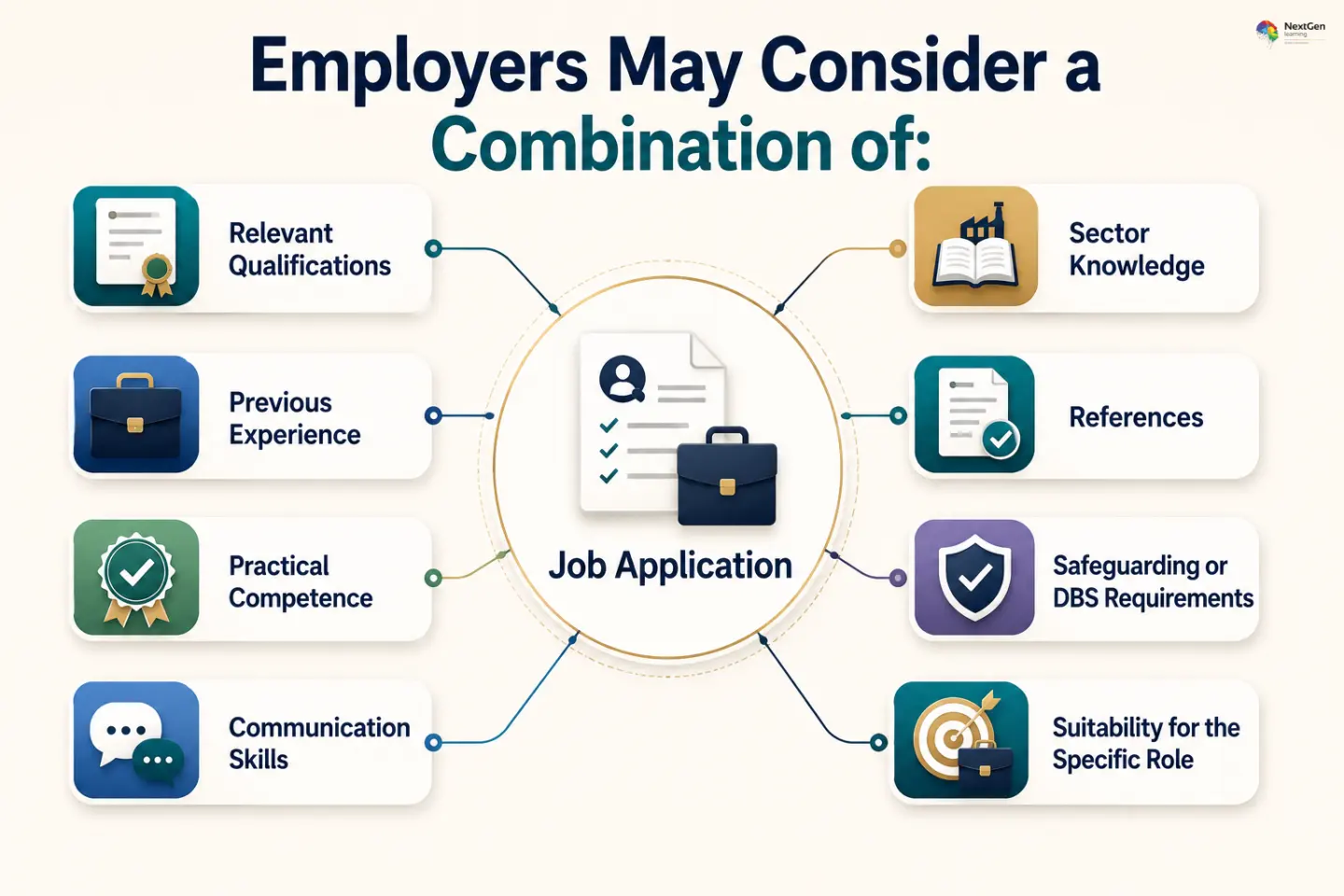
Employers may consider a combination of:
- relevant qualifications
- previous experience
- practical competence
- communication skills
- sector knowledge
- references
- safeguarding or DBS requirements
- suitability for the specific role
The strongest approach is therefore to choose a qualification that genuinely matches the job or progression route you are targeting, rather than selecting one simply because it has a higher RQF level.
Which Ofqual-Regulated Qualification Could Strengthen Your Career Profile?
The most valuable qualification is one that matches the role you want to pursue. For careers in assessment, education, quality assurance and classroom support, the following pathways may be relevant.
1. Level 3 Certificate in Assessing Vocational Achievement (RQF)
Designed for people who want to assess vocational knowledge and workplace competence. The National Careers Service’s RQF assessor career profile shows how assessment qualifications can connect with careers where professionals check vocational learning and help trainees meet required standards.
2. Level 4 Certificate in Education and Training (RQF)
Suitable for professionals developing their careers in adult or vocational education. The qualification builds knowledge of teaching, lesson planning, assessment and learner support and can strengthen applications for training and tutoring opportunities.
3. Level 4 Award in Internal Quality Assurance (RQF)
A suitable progression route for experienced assessors moving towards internal quality assurance. It develops knowledge of monitoring assessment decisions, supporting assessors and maintaining consistent assessment standards.
4. Level 3 Award in Supporting Teaching and Learning in Schools
Relevant for people interested in Teaching Assistant and learning-support roles. It develops knowledge connected with supporting pupils, safeguarding, communication and effective learning in school environments.
5. Level 3 Award in Education and Training (RQF)
A practical starting point for aspiring trainers and educators. It introduces core principles of teaching, inclusive learning, assessment and professional responsibilities and can support progression towards further education and training qualifications.
6. Level 4 Certificate for Higher Level Teaching Assistants
Designed for experienced Teaching Assistants who want to develop higher-level knowledge and prepare for increased classroom responsibilities. It can also provide useful evidence of continued professional development on a CV.
Why Relevance Matters More Than Simply Choosing a Higher Level
A Level 4 qualification is not automatically more useful to an employer than a Level 3 qualification.
What matters is whether the qualification matches the responsibilities of the job.
For example, someone seeking an assessor role may gain more career value from an appropriate Level 3 assessing qualification than from an unrelated Level 4 course. Similarly, an aspiring trainer should choose a qualification focused on education and training rather than selecting a higher level purely because it appears more advanced.
Before enrolling, consider:
- the role you want
- the qualification employers commonly request
- whether workplace experience is required
- assessment or placement requirements
- opportunities for further progression
This makes your qualification part of a clear career plan rather than simply another certificate on your CV.
How Should You Present a Regulated Qualification on Your CV?
Make the qualification easy for an employer to understand by using its full official title rather than abbreviating it unnecessarily.
For example:
Level 4 Certificate in Education and Training (RQF)
Awarding Organisation: Focus Awards
Training Provider: NextGen Learning
You can also connect the qualification to relevant skills in your personal statement or employment section. Instead of only listing the certificate, explain how your learning relates to assessment, teaching, quality assurance or learner support.
How to Check Whether a Qualification Is Regulated

Before choosing a course, verify its status rather than relying only on terms such as “accredited”, “recognised” or “certified”.
Check:
- the exact qualification title
- awarding organisation
- RQF level
- qualification number
- regulatory status
- assessment requirements
The official Register of Regulated Qualifications lets learners and employers check whether a qualification is regulated, review its details and compare similar qualifications.
Final Thoughts
Employers can value Ofqual-regulated qualifications because they provide clear evidence of structured learning, formal assessment and achievement within a regulated qualifications system.
However, regulation alone does not make a qualification right for every job. Its greatest value comes when the subject, level and assessed skills match the role you are pursuing.
For learners planning careers in vocational assessment, education, internal quality assurance or school support, selecting an appropriate regulated qualification can strengthen a CV and provide a clearer route towards professional progression.
Explore NextGen Learning’s regulated qualifications to compare the available Focus Awards pathways and choose the qualification that best matches your career goals.
Frequently Asked Questions
Employers may value Ofqual-regulated qualifications because they provide clearer evidence of structured learning, formal assessment and achievement through a recognised awarding system. Their value is strongest when the qualification is directly relevant to the role being applied for.
They are part of England’s regulated qualifications system and can provide employers with a clear indication of qualification level, subject and assessed achievement. However, individual employers decide which qualifications, experience and additional requirements they expect for a particular role.
Yes. A relevant regulated qualification can strengthen your CV by demonstrating formal learning and assessed knowledge. For clarity, include the full qualification title, RQF level and awarding organisation when listing it.
The Regulated Qualifications Framework (RQF) is used to describe the level and size of regulated qualifications. Many qualifications regulated by Ofqual sit within this framework and are assigned an RQF level.
It depends on the role. CPD certificates can be useful for continuing professional development and updating skills, while regulated qualifications provide more formal evidence of assessed learning. Employers may prefer a specific regulated qualification when it is relevant to the job requirements.
No. A regulated qualification does not guarantee a job. Employers may also consider relevant experience, practical skills, communication ability, references, DBS requirements and overall suitability for the position.
Search the official Register of Regulated Qualifications using the exact qualification title or awarding organisation. You should check the qualification number, RQF level, awarding organisation and regulatory status before enrolling.



0 responses on "Why Employers Value Ofqual-Regulated Qualifications"